Kat had booked us a hotel by the Chicago River, Club Quarters Riverside at Wacker, which proved to be old, elegant, and wonderful. I had searched Chicago’s favorite restaurants for local favorites such as Tavern Pizza, Italian Beef, Garrett’s Mix (Popcorn), German foods, and Chicago hot dogs. The best pizza joint in the city has half a dozen locations, and one was less than a quarter of a mile away. Our plan was to walk to Lou Mahlnati’s Pizzeria and dig into a thin crust with sausage and pepperoni.
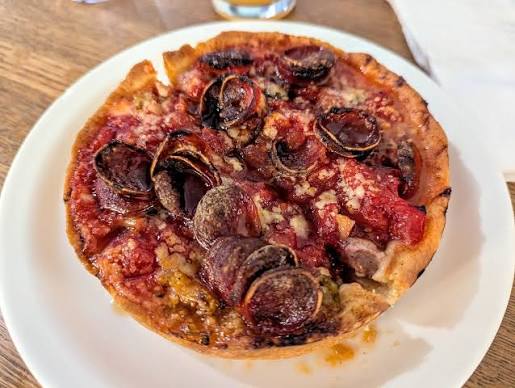
The pie was even better than billed. We chose Mike’s Hot Honey tavern style featuring sausage, pepperoni, giardiniera, and a couple of tablespoons of honey supercharged with jalapeno or cayenne, something with capsaicin. Giardiniera should be a regular on pizza, but none had ever appeared on my first thousand or so pies. It really adds crunch and picklish heat. Hot honey is another natural pizza flavor nobody uses down south. E delizioso!
Kat mentioned my birthday to our server who smiled “I’ll be right back with a surprise”. It was a huge chocolate chip cookie for two, topped with vanilla ice cream and a single candle. Quite tasteful for the cake of a septuagenarian, and oh so delizioso.
Day 2 featured a riverboat ride. First Lady Cruises operates several guided tour boats on the Chicago River, all focused on that magnificent, mostly high-rise architecture, with volunteer tour guides conversant with the great buildings and world class architects who designed them. Our guide, Claudia Winkler, surely is their very best. We’ve seen hundreds of “expert” presentations on the things we’ve paid money to see, coast to coast. None came close to matching Claudia’s degree of expertise, enthusiasm, and stream of consciousness explanation of the history of Chicago and the people who built it. She spent several minutes explaining the hydraulic systems built into each skyscraper to mitigate the blustery breezes of the Windy City. Some involve huge tanks partly filled with water to slosh against the impact of the wind; others have center weights halfway up to raise the center of gravity. Many include blow-through floors without surface skin, only the structural steel and requisite wiring and plumbing. This gives the wind a path of least resistance through the building, meaning minimal impact there, somewhat above and also below. All of this reduces the sway felt by occupants. High occupancy rates imply that this weird science works.
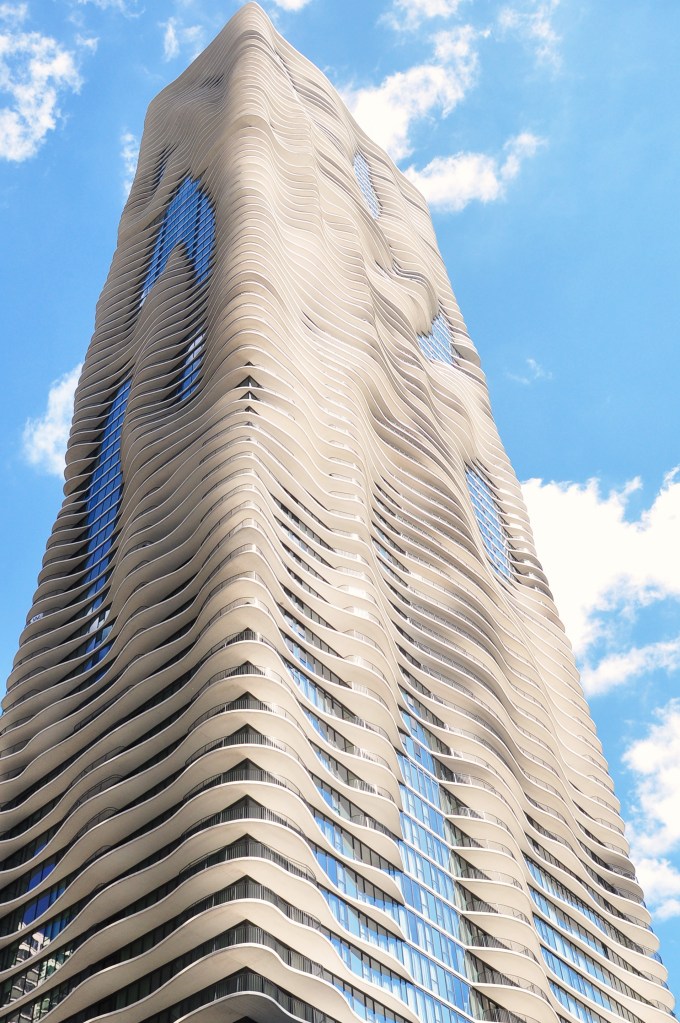
Claudia seems to be a devotee of a school of architecture known as Brutalism. It is noted by its “less is more” view of design, with a lot of visible and unapologetic concrete surfaces, uniformly sized rectangular windows which are often recessed, and an overall focus on functionality over appearance. I think if a modernish high rise seems obscenely ugly it may well be the product of a Brutalist architect. Ludwig Mies designed some that are far from ugly, yet plain with walls of identical windows. Bertrand Goldberg was proud of his Marina City Complex, but today many call his parking garages The Corncobs (because they look like well-gnawed ones standing on end.) Of the other modernists, Jeanne Gang designed lovely, wavy walled high-rises such as Aqua Tower but she’s not a Brutalist. Frank Gehry, more international than Chicago, did design the Pritzker’s Millenium Park if not the sculpture Cloud Gate, a/k/a The Bean. Frank Lloyd Wright started out in Chicago as a draftsman, but his only skyscraper, the Price Tower, is in Bartlesville, OK, undergoing renovations to transform it into a mixed use structure.
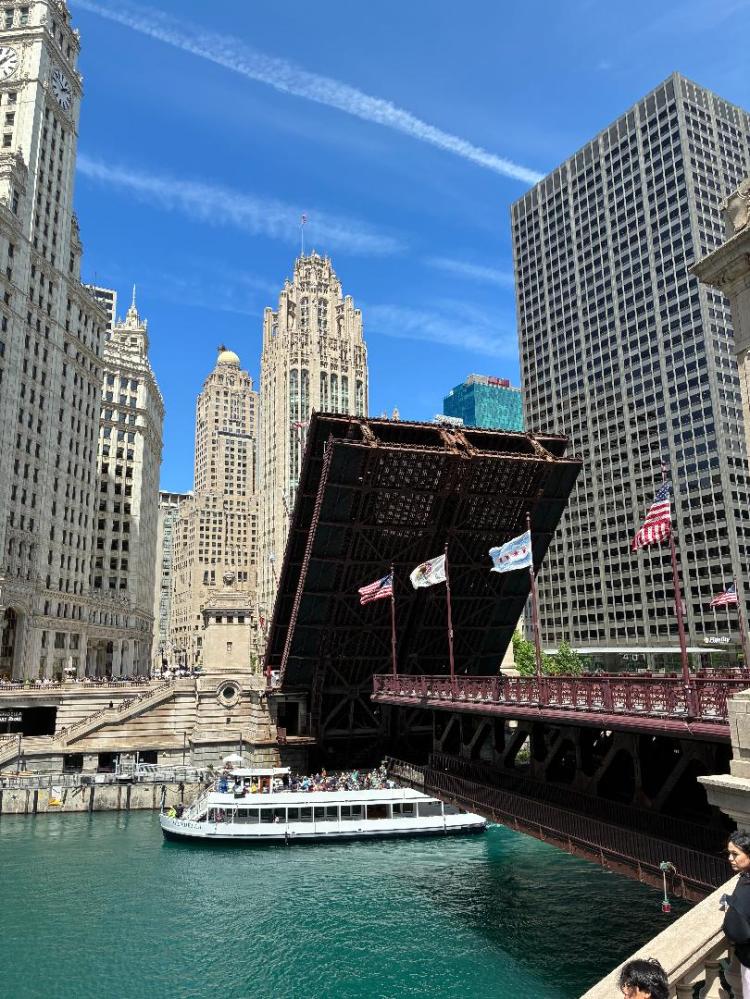
As for the Chicago River, we were treated to an only twice a week sight, the raising of the drawbridges to allow sailboats to go into Lake Michigan or return to the river. These were built in the early to mid 19th century when Chicago was for a few decades, the USA’s most active port. It served boats from the Erie Canal to the Great Lakes and on to the mighty Mississippi all the way to New Orleans. Ah, the huge building right of the bridge is of Mies design and is a fine example of Brutalism.
And as you may have heard, the city dyes the Chicago River green every St. Patrick’s Day. It stays green for a week. And after that, it returns to a slightly paler shade of green powered by algae. No fish are harmed and the water’s taste is unchanged. It’s Good Pub for a Great City.

